

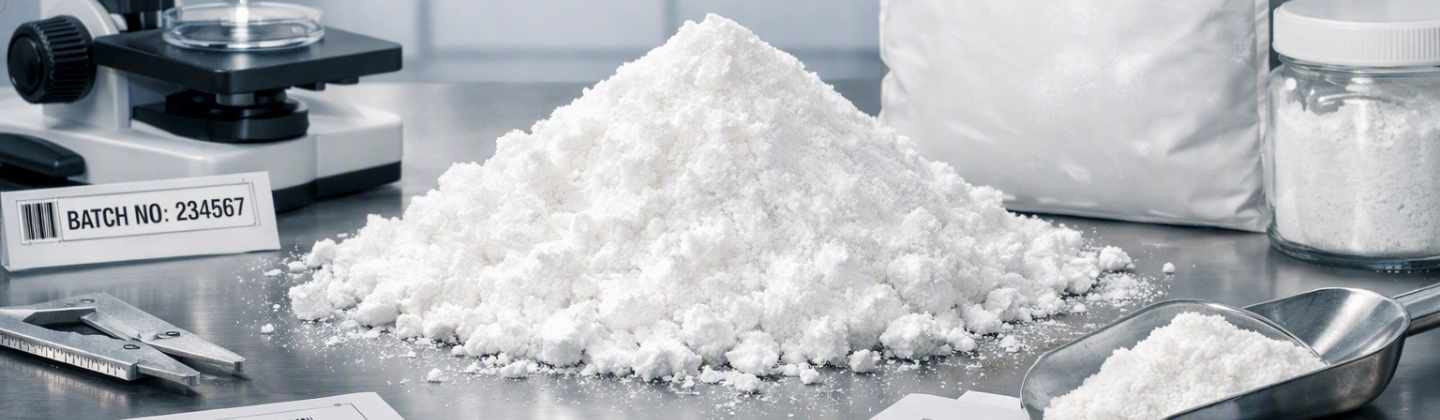
Evaluating a zinc oxide supplier requires 7 criteria: ISO 9001 certification, per-batch AAS purity CoA (≥99.0% industrial, ≥99.7% pharmaceutical), Mastersizer particle size data, REACH for EU supply, Halal or GMP for pharma, on-site lab equipment, and a minimum 10-year production track record. PT. Indo Lysaght meets all 7 with 52 years of certified zinc oxide production.
Zinc oxide (ZnO) is used in 16+ industrial sectors, from rubber vulcanization to pharmaceutical ointments. In each sector, substandard ZnO has direct, measurable consequences: inconsistent cure rates in rubber, batch rejection in pharmaceutical QA audits, color variation in ceramics, and regulatory non-compliance in sunscreen products.
The cost of switching from a substandard zinc oxide supplier is rarely just the material difference. It includes batch rejection losses, customer complaint management, regulatory re-submission fees, and reputational risk in quality audits. Evaluating your ZnO supplier correctly before committing to a supply contract is a risk management decision, not just a procurement one.
1. ISO 9001:2015 certification — confirms the supplier has a documented, audited quality management system. This is the minimum baseline; it does not guarantee product quality but confirms quality processes exist
2. Per-batch AAS purity CoA — the Certificate of Analysis must reference a specific batch/lot number and report ZnO assay (%) from Atomic Absorption Spectrometry. Acceptable minimum: ≥99.0% for industrial, ≥99.7% for pharmaceutical
3. Mastersizer particle size data — D50 and D90 from laser diffraction per batch, confirming the grade specification is met in every shipment
4. REACH registration — mandatory for EU supply and recommended for buyers with ESG supply chain disclosure requirements
5. Halal or GMP ISO 22716 — required for pharmaceutical, cosmetics, supplement, and food-adjacent applications
6. On-site laboratory — the supplier must own and operate AAS and Mastersizer instruments in-house. Outsourcing QC testing delays results and reduces traceability
7. Minimum 10-year track record — suppliers with fewer than 10 years of continuous zinc oxide production carry higher supply reliability risk. PT. Indo Lysaght has produced zinc oxide since 1974 (52 years)
A reliable CoA for zinc oxide must include:
· Lot or batch number (unique, traceable to production record)
· ZnO assay (%) — measurement method must be stated (AAS or titrimetric)
· Pb content (ppm) — below 10 ppm for pharmaceutical, below 50 ppm for industrial
· Cd content (ppm) — below 5 ppm for pharmaceutical
· Fe content (ppm) and moisture (%)
· D50 particle size (microns) with measurement instrument stated
· Test date and authorized QC signatory
Red flags in a CoA: Zinc content stated as a round number without decimal (e.g., '99.0%' with no further precision) — this is a template copy, not a test result. A genuine AAS test result will report 99.3%, 99.6%, or similar specific values. A generic CoA without a lot number is not batch-specific documentation.
|
Evaluation Point |
Qualified Supplier |
Red Flag |
|
Certification |
ISO 9001:2015 current + relevant industry cert |
No certification or expired certificate |
|
CoA |
Per-batch with lot number, AAS test values |
Generic template or periodic (not per batch) |
|
Particle size |
D50 and D90 data from Mastersizer |
No particle size data provided |
|
REACH |
Registration Certificate available |
Cannot provide REACH documentation |
|
Purity data |
Specific % (e.g., 99.63%) with method stated |
Round number (e.g., '≥99%') only |
|
Sample request |
Can ship sample within 7–14 days |
Cannot or refuses to provide samples |
|
On-site lab |
AAS + Mastersizer + BET in-house |
QC outsourced to third-party laboratory |
The following is a hypothetical illustration. All figures, processes, and technical details reflect real operating terms — the profile is entirely fictional and does not represent any real individual.
Profile: Dewi Kurniasih, 41, Head of Procurement, pharmaceutical manufacturer, Jakarta Selatan.
Project: Zinc oxide ointment production (BPOM-registered), evaluated for Malaysia export under BPOM-NPRA mutual recognition.
Condition / Problem:
· Existing supplier issued CoA quarterly (not per batch) — BPOM requires lot-specific traceability per shipment
· Pb and Cd ppm values stated only as 'compliant with specification' — no actual AAS-measured numbers per batch
· Halal certificate had lapsed 6 months earlier without renewal — documentation gap for BPOM product and Malaysia NPRA submission
Solution:
· Evaluated Indo Lysaght against 7-point supplier quality checklist:
· 1. ISO 9001:2015 ✓ | 2. Per-batch AAS CoA with specific decimal purity + Pb/Cd ppm per lot ✓
· 3. Mastersizer D50/D90 ✓ | 4. REACH 2018 ✓ | 5. Halal MUI + GMP ISO 22716 (2017) ✓
· 6. In-house AAS + Mastersizer + BET instruments ✓ | 7. 52 years of continuous production ✓
· Sample CoAs from 3 recent batches reviewed and verified before first order
Result:
· Zero batch rejections across 18 months and 6 procurement cycles
· BPOM annual facility audit: passed — no non-conformances related to ZnO documentation
· Malaysia NPRA mutual recognition submission approved — Indo Lysaght CoA accepted as supporting documentation
Consider reviewing your current zinc oxide supplier if any of the following apply:
· Your current supplier provides a periodic CoA rather than a per-batch document with a lot number
· You cannot find REACH documentation and you supply European or internationally regulated customers
· Your pharmaceutical or cosmetics product line requires Halal certification that your ZnO supplier cannot provide
· Your QA team has flagged batch-to-batch purity variation but the supplier cannot provide specific AAS test values
· The 7 criteria: ISO 9001, per-batch AAS CoA, Mastersizer D50 data, REACH, Halal/GMP, on-site lab, and 10-year track record together predict both product quality and supply reliability
· The most common qualification gap is CoA quality: a batch-specific CoA with explicit purity values and a lot number is a non-negotiable for industrial, pharmaceutical, and export applications
· PT. Indo Lysaght meets all 7 criteria with 52 years of zinc oxide production, 9 active certifications, and AAS + Mastersizer + BET instrumentation operated in-house
Q: What certifications must a ZnO supplier have for pharmaceutical applications?
A: For pharmaceutical ZnO, the supplier must hold: ISO 9001:2015 for quality management, Halal certification (BP POM MUI for Indonesia) if supplying Muslim-majority markets, GMP ISO 22716 for cosmetics and personal care overlap, and HACCP if the product contacts food-adjacent applications. Each batch needs an AAS-verified CoA showing purity ≥99.7% and Pb/Cd below USP/BP limits (Pb <10 ppm).
Q: How do I evaluate zinc oxide purity from a Certificate of Analysis?
A: A reliable CoA includes ZnO assay ≥99.0% (industrial) or ≥99.7% (pharmaceutical) stated as a decimal value from AAS testing, Pb below 10 ppm (pharmaceutical) or 50 ppm (industrial), Cd below 5 ppm, Fe below 50 ppm, and moisture below 0.5%. The CoA must reference a unique batch/lot number for traceability. Round values without a lot number indicate a generic template — not a batch test result.
Q: How many years of track record should a ZnO supplier have?
A: For critical industrial, pharmaceutical, or export applications, a supplier with fewer than 10 years of continuous zinc oxide production carries higher supply reliability risk. PT. Indo Lysaght has produced zinc oxide since 1974 — 52 years — and distributed over 500,000 metric tons globally across 16 industries. Request supply references from buyers in your industry with 3+ years of continuous supply.
Q: Does the ZnO supplier need REACH registration for EU customers?
A: Yes. REACH (EU Regulation 1907/2006) requires zinc oxide imported into the EU above 1 metric ton per year to be registered. Most European industrial buyers require their suppliers to hold REACH registration. PT. Indo Lysaght obtained REACH registration in 2018, enabling direct supply to EU-linked supply chains without requiring European importers to carry the registration burden.
Q: What on-site lab equipment should a qualified ZnO supplier have?
A: A qualified zinc oxide supplier should operate in-house: Atomic Absorption Spectrometer (AAS) for zinc purity and heavy metals (Pb, Cd, Fe, Mn, Cu, Co, Ni), Malvern Mastersizer for particle size distribution (D50, D90), and BET/Langmuir analyzer for surface area measurement. PT. Indo Lysaght operates all three in-house, enabling per-batch CoA issuance without third-party lab dependency or processing delays.
