

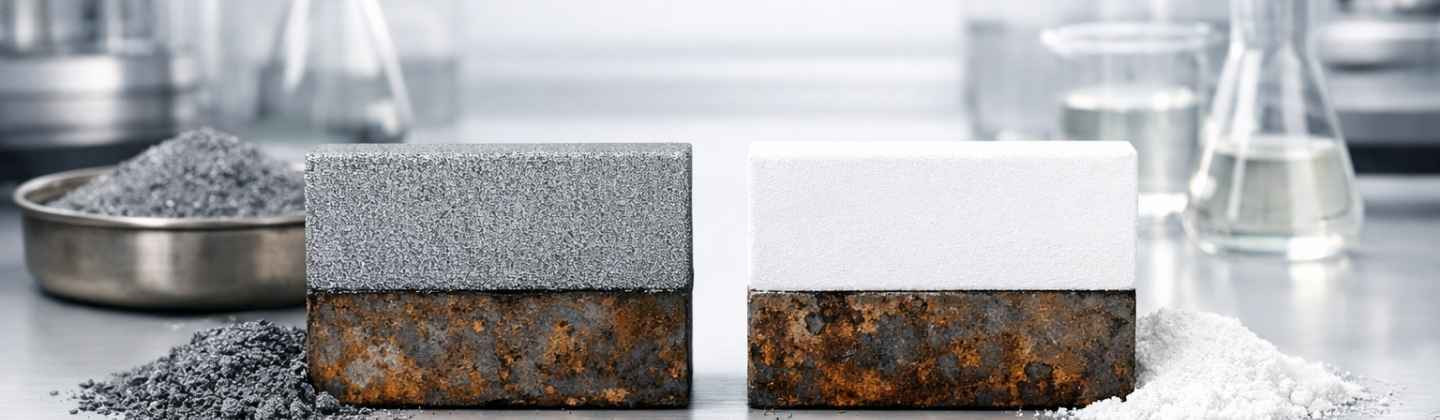
Zinc dust and zinc oxide protect coatings differently: zinc dust can support galvanic protection through metallic zinc contact, while zinc oxide often supports barrier strength, UV stability, and film performance. PT Indo Lysaght supplies both zinc-based materials, giving industrial buyers a clearer path to compare 2 functions in corrosion-control systems.
Zinc dust is finely divided metallic zinc. In zinc-rich primer systems, it can support galvanic or sacrificial protection when the coating design allows sufficient zinc-to-zinc and zinc-to-steel contact.
This function depends on more than simply adding zinc dust. Particle size, metallic zinc content, binder compatibility, film thickness, and application control all influence whether the primer can perform as intended.
For steel structures, marine assets, and infrastructure components, zinc dust is usually discussed as an active protection material in primer layers rather than a general filler.
Zinc oxide is an oxidized zinc compound, not metallic zinc dust. In coating systems, it is more commonly associated with film support, weathering behavior, UV stability, opacity, and formulation balance depending on grade and particle size.
Because zinc oxide is already oxidized, it should not be treated as a direct 1-to-1 replacement for zinc dust when the target is galvanic behavior. It can still be valuable in coatings, but the mechanism is different.
The easiest way to compare both materials is to separate chemistry, function, and buyer checks.
|
Material |
Main Corrosion-Related Role |
Typical Coating Role |
Buyer Checks |
|
Zinc dust |
Supports galvanic behavior when metallic zinc contact is achieved. |
Zinc-rich primer and steel protection system. |
Metallic zinc content, particle size, moisture, dispersion, binder fit. |
|
Zinc oxide |
Supports coating durability and film properties in selected systems. |
Pigment, functional filler, durability-support material. |
Grade, particle size, purity, whiteness, moisture, impurities. |
|
Both materials |
Can appear in coating discussions, but not for the same reason. |
Application-specific formulation input. |
COA, TDS, supplier documentation, sample validation. |
Selection should begin with the performance target, not the raw material name. Use the 4 questions below before requesting a quotation.
1. Does the steel need active galvanic protection or general coating durability support?
2. Is the material used in the primer, intermediate coat, topcoat, or a non-coating process?
3. Which quality parameter controls the outcome: metallic zinc content, grade, particle size, moisture, or impurity profile?
4. Can the supplier provide COA, TDS, and technical support for the intended coating system?
A corrosion specification that confuses zinc dust and zinc oxide can cause rework, failed trials, or incorrect supplier evaluation. The two materials contain zinc, but their chemical state and coating function are different.
PT Indo Lysaght supplies zinc dust and zinc oxide, which allows buyers to discuss both materials within one zinc-based supplier context. The practical advantage is clearer technical comparison before sample approval.
Scenario note: The following scenario is a hypothetical illustration based on industrial buyer situations. Use approved internal product specifications, laboratory data, and customer permission before publishing any real customer case study.
A steel fabricator preparing an outdoor structure compares 2 coating approaches: a standard zinc oxide-filled coating and a zinc-rich primer using zinc dust. After reviewing the system design, the team separates the roles: zinc dust in the primer layer for active protection and zinc oxide in compatible coating layers for durability support.
The revised specification reduces rework from 7 panels to 2 panels during a 30-day trial inspection. The improvement comes from clarifying material function before purchasing, not from assuming that every zinc-based input works the same way.
Discuss specifications when the coating system must meet corrosion testing, when the project involves marine or infrastructure exposure, or when a formulation change involves zinc-based materials.
PT Indo Lysaght can support product information discussions for both zinc dust and zinc oxide. For COA/TDS review or sample consultation, contact cs@indolysaght.com or Marketing Office (+62) 21 6531 1333.
· Zinc dust and zinc oxide differ most clearly in chemistry, reactivity, and coating function.
· Zinc dust is the material usually linked to galvanic behavior in zinc-rich primer systems.
· Zinc oxide supports coating durability differently and should be selected by grade, particle size, and formulation fit.
Q: Which is better for corrosion protection, zinc dust or zinc oxide?
A: Neither is universally better because they serve 2 different roles. Zinc dust is typically associated with active galvanic protection in zinc-rich primers, while zinc oxide supports coating properties such as durability and weathering. The right choice depends on the coating layer, exposure condition, and performance test target.
Q: Can zinc oxide replace zinc dust in zinc-rich primer?
A: Zinc oxide should not be treated as a direct 1-to-1 replacement for zinc dust in zinc-rich primer. Zinc dust contains metallic zinc needed for galvanic behavior, while zinc oxide is already oxidized. Any substitution should be validated through formulation testing and supplier documentation.
Q: Why is zinc dust used for steel structure protection?
A: Zinc dust is used because metallic zinc can support sacrificial or galvanic protection when coating design allows sufficient contact. In steel protection, this function is most relevant in zinc-rich primer systems. Buyers should review metallic zinc content, particle size, and binder compatibility before approval.
Q: How does zinc oxide help coating durability?
A: Zinc oxide can support coating durability by improving 3 properties: film strength, UV resistance, and compatibility in selected formulations. It does not provide the same galvanic function as zinc dust, but it can help coatings maintain stability and performance when the correct grade and particle size are used.
