

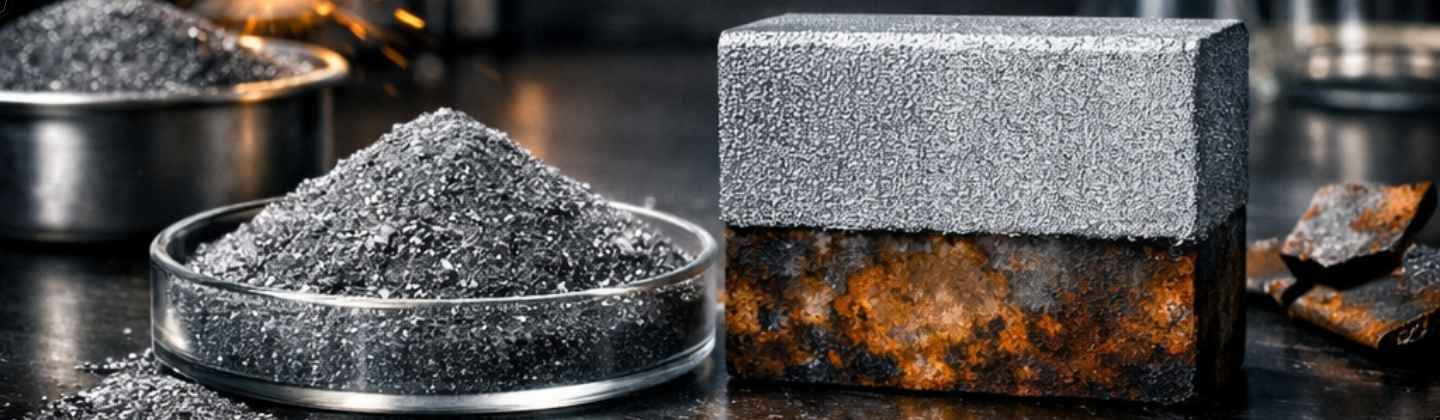
Zinc dust purity affects coating durability because metallic zinc content, impurities, moisture, and particle consistency influence how well a protective system performs over time. PT Indo Lysaght, operating since 1974, can be positioned around certified quality systems and documented zinc dust control for buyers evaluating durable industrial coatings.
In protective coatings, zinc dust purity is usually discussed in relation to metallic zinc content and impurity control. The goal is not only to know that zinc is present, but also to know how consistently the zinc dust supports the intended coating function.
Purity should be reviewed in a batch-specific COA. Buyers should also examine related parameters, because coating durability can be influenced by moisture, particle size distribution, binder compatibility, substrate preparation, and application conditions.
Purity can affect coating durability through several pathways. The 4 mechanisms below are useful for technical buyers and formulators.
1. Metallic zinc content helps determine whether the zinc dust can support the intended protective function.
2. Impurities may influence reactivity, dispersion, or film behavior in sensitive systems.
3. Moisture can affect handling, storage stability, and mixing behavior.
4. Batch consistency helps the coating producer repeat successful trial results during regular production.
A high-purity zinc dust can still underperform if it is not matched to the coating formulation. Use the table below to avoid evaluating purity in isolation.
|
Variable |
Impact on Coating Durability |
Buyer Check |
|
Purity |
Supports expected zinc function and reduces unknown material variation. |
Compare actual COA values with the specification. |
|
Particle size distribution |
Influences contact, dispersion, and settling behavior. |
Ask whether particle profile fits the primer system. |
|
Moisture |
Affects storage, mixing, and film consistency. |
Define maximum acceptable moisture level internally. |
|
Binder compatibility |
Determines whether zinc dust works in the coating system. |
Validate through formulation trials. |
|
Substrate preparation |
Controls whether coating can perform on steel. |
Align material testing with surface preparation standard. |
Coating manufacturers should evaluate zinc dust purity before production trials, not after defects appear. A practical review includes 5 steps.
5. Define purity and impurity limits for the intended coating system.
6. Request a batch-specific COA and technical data sheet.
7. Compare actual values to written purchase specification limits.
8. Run a lab or pilot sample under the intended coating process.
9. Record acceptance criteria and keep them consistent for repeat orders.
PT Indo Lysaght is positioned as a zinc dust and zinc oxide manufacturer with a long operating history since 1974. For coating buyers, the useful discussion is how supplier documentation, quality systems, and material consistency can support raw material approval.
Certifications such as ISO 9001-2015, ISO 14001-2015, REACH, SNI, and PROPER can support supplier qualification. However, buyers should still request current product documents and batch-specific COA data before approval.
Scenario note: The following scenario is a hypothetical illustration based on industrial buyer situations. Use approved internal product specifications, laboratory data, and customer permission before publishing any real customer case study.
A protective coating plant prepares 12 steel test panels using 2 zinc dust lots with different impurity profiles. After 4 weeks of internal exposure screening, 3 panels from the less controlled lot show uneven film behavior.
The team adds a purity and impurity review to incoming QC, then repeats the test with documented acceptance limits. Nonconforming panels fall from 25% to 8% in the next trial. The scenario shows why purity review should be tied to full coating validation.
Contact a manufacturer when purity data is unclear, when a coating system is failing trial checks, or when a project requires documented quality evidence before approval.
PT Indo Lysaght can support product information and COA/TDS discussions for zinc dust buyers. Contact cs@indolysaght.com or Marketing Office (+62) 21 6531 1333.
· Purity affects coating durability, but it should be reviewed with particle size, moisture, impurities, and formulation fit.
· The COA should show batch-specific values and should be compared with written purchase limits.
· For critical coating systems, sample testing remains necessary before commercial approval.
Q: Does higher zinc dust purity always mean better coating durability?
A: Higher purity can support coating durability, but it is not the only factor. Buyers should evaluate at least 5 variables: metallic zinc content, impurity profile, particle size distribution, moisture, and formulation compatibility. A high-purity material can still underperform if it does not match the coating system.
Q: How do impurities affect zinc-rich coatings?
A: Impurities can affect coating behavior by changing reactivity, dispersion, film stability, or long-term consistency. The practical risk is not only one impurity value, but variation between batches. Buyers should compare COA results against written limits before approving zinc dust for production.
Q: What COA fields matter for zinc dust purity?
A: A useful COA should show at least 4 purity-related items: batch number, test method or reference, actual purity result, and impurity results. For coating durability, the COA should be reviewed together with particle size, moisture, and the coating formulation requirement.
Q: When should a coating manufacturer retest zinc dust purity?
A: Retest zinc dust purity when changing suppliers, changing coating formulation, receiving a new batch for critical projects, or seeing unexpected durability results. These 4 situations carry higher production risk because a small raw material change can affect coating performance at scale.
