

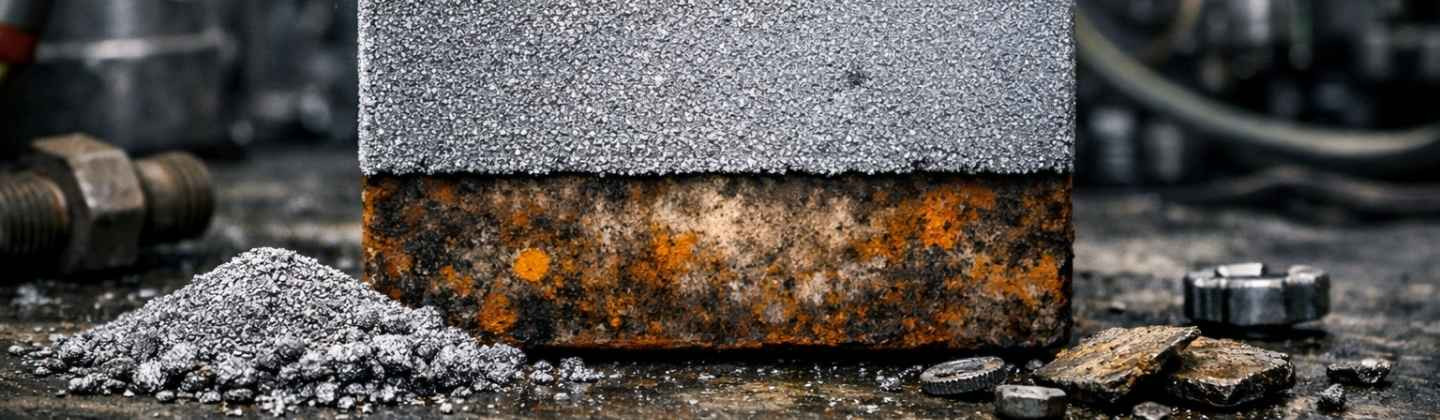
Zinc dust works as an industrial material because it is finely divided metallic zinc with high surface contact and useful reactivity. PT Indo Lysaght, founded in 1974, can connect this material to at least 4 industrial needs: anti-corrosion coatings, chemical manufacturing, mining applications, and specialized formulation support.
Zinc dust is a fine particle form of metallic zinc. This is different from zinc oxide, which is already an oxidized zinc compound. The metallic form is one reason zinc dust behaves differently in coatings, chemical processes, and selected industrial systems.
Because zinc dust is finely divided, it offers more surface contact than larger pieces of zinc. That surface contact can influence reactivity, dispersion, and interaction with other materials in a formulation or process.
Fine particle form changes how zinc dust works in at least 4 ways.
1. It increases contact area between metallic zinc and the surrounding system.
2. It can improve dispersion when the particle size matches the formulation method.
3. It can increase apparent reactivity in applications where surface contact matters.
4. It can also increase handling and dust-control requirements, so storage and process safety should be reviewed.
Zinc dust is used across several industrial categories, but each category values different material properties.
|
Application Area |
How Zinc Dust Works |
Quality Factor to Check |
|
Anti-corrosion coatings |
Supports metallic zinc behavior in zinc-rich primer systems. |
Metallic zinc content, particle size, moisture, dispersion. |
|
Chemical manufacturing |
Acts as a zinc-based material where controlled reactivity is needed. |
Purity, impurity profile, surface area, batch consistency. |
|
Mining-related use |
Serves as an industrial zinc input in selected processes. |
Specification fit, moisture, packaging, traceability. |
|
Electronics or textile-related use |
May support specialized formulation or processing needs. |
Application-specific grade, COA, sample validation. |
A zinc dust buyer should start with the industrial function, then build the specification. Use this 5-step framework.
5. Define the application and the expected material function.
6. Identify the most important performance target in that application.
7. Request TDS, COA, certification, and packaging information.
8. Test a sample batch under real operating or formulation conditions.
9. Approve suppliers based on repeatability, not only on one successful trial.
PT Indo Lysaght is positioned around zinc oxide, zinc dust, zinc chemicals, and zinc oxide granular manufacturing and supply. For buyers, this matters because zinc-based material selection often requires comparison between related zinc forms.
The company profile includes quality and trust signals such as ISO 9001-2015, ISO 14001-2015, REACH, SNI, Halal Certificate, and PROPER. These credentials should be combined with current product documents and application-specific sample testing.
Scenario note: The following scenario is a hypothetical illustration based on industrial buyer situations. Use approved internal product specifications, laboratory data, and customer permission before publishing any real customer case study.
A multi-plant industrial buyer initially uses 1 zinc dust specification for both coating trials and chemical manufacturing. After 2 failed trials, the team separates the requirement into 2 material profiles: one focused on coating dispersion and one focused on controlled reactivity.
With separate COA review and sample testing, approval time drops from 6 weeks to 3 weeks for the next evaluation cycle. The scenario shows how zinc dust selection improves when the buyer defines function before specification.
Work with a zinc dust manufacturer when you need to compare application fit, review COA/TDS data, or qualify a material for recurring industrial use.
PT Indo Lysaght can discuss zinc dust and zinc oxide product information for industrial buyers. Contact cs@indolysaght.com or Marketing Office (+62) 21 6531 1333.
· Zinc dust works because it is metallic zinc in fine particle form.
· Its industrial value depends on how surface contact, reactivity, and specification fit the application.
· Buyers should validate zinc dust through COA review, sample testing, and supplier qualification.
Q: What makes zinc dust useful in industry?
A: Zinc dust is useful because it combines metallic zinc chemistry with a fine particle form. These 2 features allow it to support functions such as anti-corrosion coating, chemical reaction support, and specialized industrial formulation. Performance depends on particle size, purity, moisture, and batch consistency.
Q: Why is zinc dust more reactive than zinc oxide?
A: Zinc dust is generally more reactive because it contains metallic zinc, while zinc oxide is already oxidized. The fine particle form also increases surface contact. This difference is why zinc dust is used in applications where metallic zinc behavior matters, such as zinc-rich primers or selected chemical processes.
Q: Which industries commonly use zinc dust?
A: Zinc dust is used across several industrial sectors, including coatings, mining, chemical manufacturing, electronics-related processes, and textile-related applications. The exact specification may differ across 4 major factors: purity, particle size distribution, moisture, and impurity profile. Buyers should not use one generic specification for every industry.
Q: How should buyers choose zinc dust for industrial use?
A: Buyers should choose zinc dust through a 5-step process: define the application, identify performance targets, request technical data, review COA results, and test a sample batch. This helps avoid mismatch between the material name and the actual industrial function required.
