

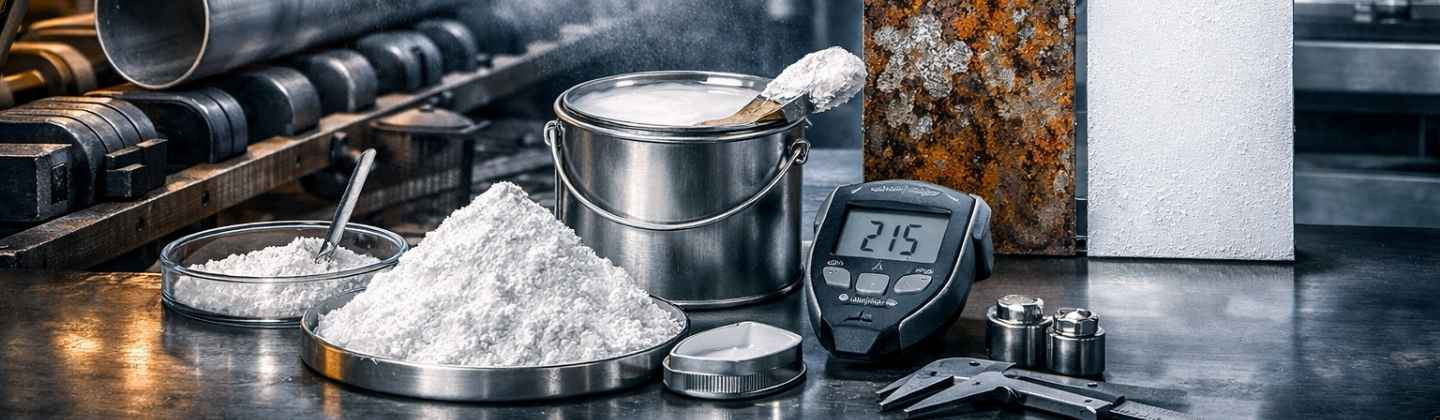
Zinc oxide can improve coating durability by supporting film stability, UV resistance, dispersion, and formulation consistency when the right grade is selected. PT Indo Lysaght, founded in 1974, can connect zinc oxide quality to coating performance through 4 buyer checks: particle size, purity, moisture, and supplier documentation.
Zinc oxide is used in coating systems because it can support formulation-level durability. Depending on grade and formulation, it may contribute to film stability, UV exposure resistance, dispersion behavior, and consistent appearance.
This does not mean zinc oxide works the same way as zinc dust. Zinc dust is commonly discussed in zinc-rich primer systems for galvanic behavior, while zinc oxide supports coating performance through different material properties.
For industrial buyers, the main question is not whether zinc oxide is useful. The question is whether the selected grade and particle size match the coating system.
Before approving zinc oxide for coatings, buyers should review 4 practical quality factors.
|
Quality Factor |
How It Affects Coating Durability |
Buyer Check |
|
Particle size |
Influences dispersion, surface interaction, opacity, and finish. |
Match particle profile to coating type and mixing process. |
|
Purity |
Supports formulation consistency and reduces unknown variation. |
Review batch-specific COA values. |
|
Moisture |
Affects storage, mixing, and stability. |
Define acceptable moisture range internally. |
|
Supplier documentation |
Supports repeat approval and troubleshooting. |
Request TDS, COA, certifications, and traceability. |
Zinc oxide and zinc dust should not be compared only by zinc content. Zinc dust contains metallic zinc and can support galvanic behavior in zinc-rich primers when the system is designed correctly.
Zinc oxide is already oxidized, so it usually supports coating durability through film and formulation properties instead of metallic zinc protection. A buyer should select by coating layer, performance target, and technical documentation.
A practical zinc oxide selection process includes 5 steps.
1. Define the coating type and performance requirement.
2. Identify the grade and particle size profile needed for that formulation.
3. Request TDS, COA, and supplier certifications.
4. Run a sample in the actual coating system and mixing process.
5. Record the acceptance criteria for future batches.
A mismatched zinc oxide grade may contribute to poor dispersion, uneven finish, settling, or inconsistent batch behavior. These issues can also involve binder choice, mixing conditions, pigment balance, or storage practices, so raw material review should be part of a broader formulation audit.
PT Indo Lysaght can be positioned as a manufacturer for buyers who need product information and documentation when evaluating zinc oxide for coating applications.
Scenario note: The following scenario is a hypothetical illustration based on industrial buyer situations. Use approved internal product specifications, laboratory data, and customer permission before publishing any real customer case study.
A coating formulator sees visible settling in 4 of 16 pilot batches using a generic zinc oxide grade. The team compares particle size, moisture, and supplier documentation before testing a better-matched grade profile.
After 2 pilot cycles, settling observations fall from 25% to 6.25%, and the material approval file includes a clearer COA review process. The scenario shows why grade selection and documentation should be evaluated together.
Talk to a zinc oxide manufacturer when a coating system changes, when particle size or grade must be reviewed, or when sample behavior does not match the COA expectation.
For zinc oxide product information and documentation review, contact PT Indo Lysaght at cs@indolysaght.com or Marketing Office (+62) 21 6531 1333.
· Zinc oxide supports coating durability through film stability, UV resistance, dispersion, and formulation consistency.
· The 4 first buyer checks are particle size, purity, moisture, and supplier documentation.
· Zinc oxide should not be treated as zinc dust; each material serves a different coating role.
Q: How does zinc oxide improve coating durability?
A: Zinc oxide can improve coating durability by supporting film stability, UV resistance, dispersion, and formulation consistency. These benefits depend on at least 4 factors: particle size, purity, moisture, and compatibility with the coating system. The correct grade should be validated through sample testing.
Q: Does zinc oxide protect coatings like zinc dust?
A: Zinc oxide and zinc dust protect coatings in different ways. Zinc dust can support galvanic protection in zinc-rich primers, while zinc oxide more often supports film properties and durability. Buyers should compare the 2 materials by function, not only by zinc content.
Q: Why does zinc oxide particle size matter in coatings?
A: Particle size matters because it affects dispersion, surface interaction, opacity, and film appearance. A mismatch can create problems such as poor dispersion or inconsistent finish. Coating buyers should review particle size distribution alongside purity and moisture before approving a zinc oxide grade.
Q: What should coating manufacturers ask zinc oxide suppliers?
A: Coating manufacturers should ask for at least 5 items: technical data sheet, COA, particle size information, impurity profile, and sample availability. For critical coatings, they should also ask how batch consistency is controlled before moving from lab trial to production.
