

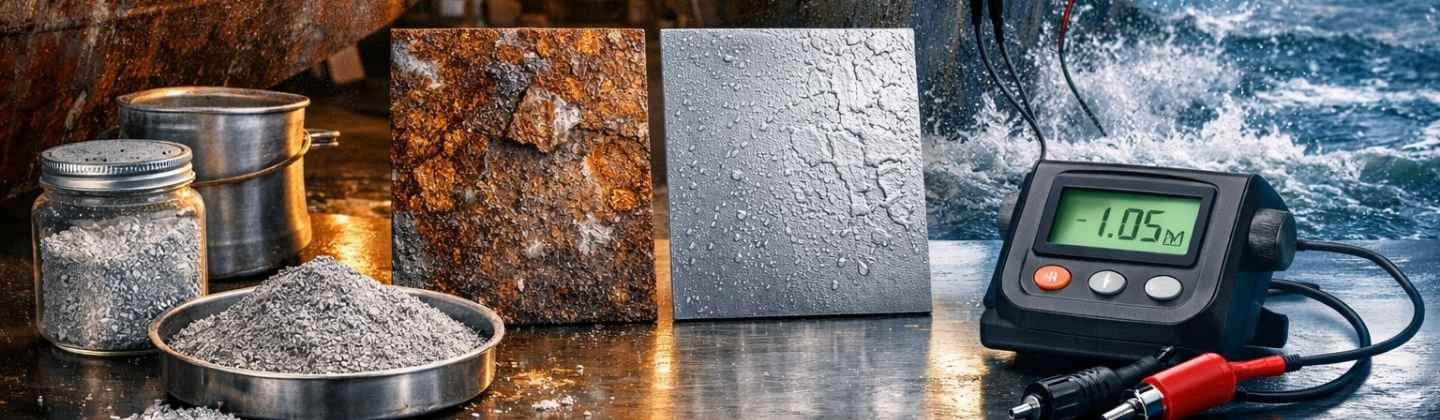
Conventional barrier coatings, epoxy, alkyd, polyurethane, protect steel by blocking moisture and oxygen. This approach fails at any discontinuity: welds, edges, mechanical damage, or fastener holes. Once the barrier is breached, moisture reaches the steel and corrosion begins. Worse, corrosion spreads laterally under the intact coating (undercutting), invisibly weakening the structure.
In marine and coastal industrial environments, steel corrodes at rates of 0.05–0.1 mm per year, 5 to 10 times faster than in inland atmospheric conditions. For a bridge main girder or offshore platform leg, this is structurally significant within 5–7 years if only barrier protection is used.
The solution requires a fundamentally different protection mechanism: cathodic protection, delivered through zinc-rich primer using zinc dust.
The galvanic series ranks metals by their electrochemical potential. Zinc sits at −0.76 V (vs. Standard Hydrogen Electrode), significantly more negative than iron at −0.44 V. When zinc and iron are in electrical contact in the presence of an electrolyte (moisture), zinc becomes the anode and iron becomes the cathode.
In a zinc-rich primer, zinc dust particles form direct electrical contact with the steel substrate. When the coated assembly encounters moisture, salt spray, condensation, or immersion, zinc particles begin to oxidize preferentially. The zinc 'sacrifices' itself electrochemically, converting to zinc hydroxide and zinc oxide, while the underlying steel is protected by the resulting cathodic current.
Critically, this protection is active even at coating damage points. Within approximately 10–20 mm of a scratch or cut edge, the cathodic throw radius, zinc ions migrate through electrolyte to suppress iron oxidation. No barrier coating can offer this.
In marine environments, zinc-rich primer must withstand continuous salt spray, high humidity, and frequent condensation. The amount of cathodic protection depends on how many zinc particles are in electrical contact with each other and with the steel substrate, a function of particle packing density in the dry film.
Smaller zinc dust particles (lower D50) pack more densely per unit volume of DFT, creating more zinc-steel contact paths. Indo Lysaght F-3000 (D50: 3.2–4.2 microns, zinc ≥99.0%) achieves the particle density required for IMO PSPC-compliant coatings. F-2000 (D50: ~4–5 microns) is suited for ISO 12944 category C5-M atmospheric marine exposure.
Three standards govern zinc-rich primer selection for marine and infrastructure applications:
· IMO PSPC (Performance Standard for Protective Coatings): Governs ballast water tank and void space coatings on vessels. Requires minimum 1,000-hour salt spray resistance (ASTM B117) without rust creep for the coating system. Zinc-rich primer is the industry standard primer under this requirement.
· ISO 12944: Categorizes corrosivity environments from C1 (very low) to C5-M (very high, marine). Marine structures typically require systems rated for C5-M or Im1/Im2 (immersed). Zinc-rich primers are specified as part of system schemes for these categories.
· SSPC SP-10: Near-White Blast Cleaning (Sa 2.5 per ISO 8501-1), surface profile 40–70 microns Rz, the minimum surface preparation standard before applying zinc-rich primer in marine environments.
For international offshore projects and vessels calling at European ports, suppliers of zinc dust must hold REACH registration (EU Regulation 1907/2006). Indo Lysaght obtained REACH registration for zinc dust in 2018.
1. Specify grade F-2000 (ISO 12944 C5-M, atmospheric) or F-3000 (IMO PSPC, immersed/offshore)
2. Require zinc content ≥99.0% by AAS, verified per batch
3. Request D50 and D90 data from Mastersizer, not just grade name
4. Confirm UN packaging standard (antistatic jumbo bag or sealed steel pail)
5. Confirm REACH registration certificate for international project supply
The following is a hypothetical illustration. All figures, processes, and technical details reflect real operating terms. The profile is entirely fictional and does not represent any real individual.
Profile: Ahmad Fauzi, 52, Procurement Manager, marine coating supplier, Batam.
Project: Supply of zinc-rich primer for 3 cargo vessel ballast tank projects. IMO PSPC Category 1 compliance required.
Condition / Problem:
· Previous supplier could not provide REACH Registration, required for EU-linked vessel contracts
· No per-batch D50 particle size data, only grade name, no verification
· Without REACH and D50 data, compliance audit was at risk of failure within a 21-day deadline
Solution:
· Specified Indo Lysaght F-3000 (D50: 3.2–4.2 microns, Zn ≥99.0%)
· REACH Registration Certificate (2018) available immediately for download
· Per-batch Mastersizer D50/D90 CoA included in every shipment
· UN-standard antistatic jumbo bag 400 kg, compatible with Batam port logistics
Result:
· Salt spray test ASTM B117: 1,440 hours without rust creep (IMO PSPC minimum: 1,000 hours, exceeded by 44%)
· Compliance audit for all 3 vessels: passed, zero deficiencies on material documentation
· Indo Lysaght established as primary zinc dust supplier for future marine projects
Your zinc dust supplier specification may need upgrading if any of the following apply to your current marine or infrastructure projects:
· Your coating system targets IMO PSPC or ISO 12944 C5-M but your zinc dust CoA does not specify D50
· Your supplier cannot provide REACH registration documentation for international vessel projects
· Your salt spray test results are below 1,000 hours with current zinc-rich primer system
· You are using F-500 for marine applications, the D50 range may be too coarse for adequate packing density
· Zinc dust provides cathodic protection by exploiting the electrochemical potential difference between zinc (−0.76 V) and iron (−0.44 V), no barrier coating can replicate this active, self-healing protection mechanism
· Marine and offshore applications require F-3000 (D50: 3.2–4.2 microns) for IMO PSPC compliance; F-2000 suits ISO 12944 C5-M atmospheric marine environments
· Request REACH registration, per-batch CoA with D50/D90, and UN packaging documentation before committing zinc dust supply for any international marine project
Q: What zinc dust grade is required for IMO PSPC ballast tank compliance?
A: IMO PSPC for ballast tanks requires zinc-rich primer systems achieving minimum 1,000 hours salt spray resistance (ASTM B117) without rust creep. This requires zinc dust with D50 ≤5 microns and zinc content ≥99.0%. Indo Lysaght F-3000 (D50: 3.2–4.2 microns) is engineered for IMO PSPC applications, with REACH registration and per-batch AAS-verified CoA.
Q: What is the minimum zinc content in zinc dust for cathodic protection?
A: Raw zinc dust must contain ≥99.0% total zinc to ensure the dry zinc-rich primer film achieves adequate electrochemical potential for cathodic protection, minimum −850 mV vs. SCE on the steel substrate. Indo Lysaght's F-500, F-1000, F-2000, and F-3000 grades all meet the 99.0% minimum specification, verified by AAS testing per batch with lot-referenced CoA.
Q: How does F-3000 differ from F-2000 for marine coating applications?
A: F-3000 (D50: 3.2–4.2 microns) produces higher particle packing density in the primer matrix, critical for immersed conditions (Im1/Im2 per ISO 12944) and offshore environments requiring maximum cathodic continuity. F-2000 (D50: ~4–5 microns) is suited for high-humidity atmospheric marine environments (C5-M) where immersion is not the primary exposure. Both grades meet zinc ≥99.0% minimum.
Q: Does zinc dust need REACH registration for international offshore projects?
A: Yes. Projects involving European offshore platforms, vessels, or ports require raw material suppliers, including zinc dust, to hold REACH registration under EU Regulation 1907/2006. PT. Indo Lysaght obtained REACH registration for zinc dust in 2018, making it one of the few Indonesian zinc dust manufacturers compliant for EU-linked international supply chains.
Q: What surface preparation is required before applying zinc-rich primer?
A: SSPC SP-10 Near-White Blast Cleaning (Sa 2.5 per ISO 8501-1) is the minimum surface preparation for marine and offshore applications. A surface profile of 40–70 microns Rz is typically specified. Proper surface preparation is essential, zinc-rich primer cannot compensate for inadequate blast cleaning, and any residual millscale or contamination will cause adhesion failure regardless of zinc dust grade.
