

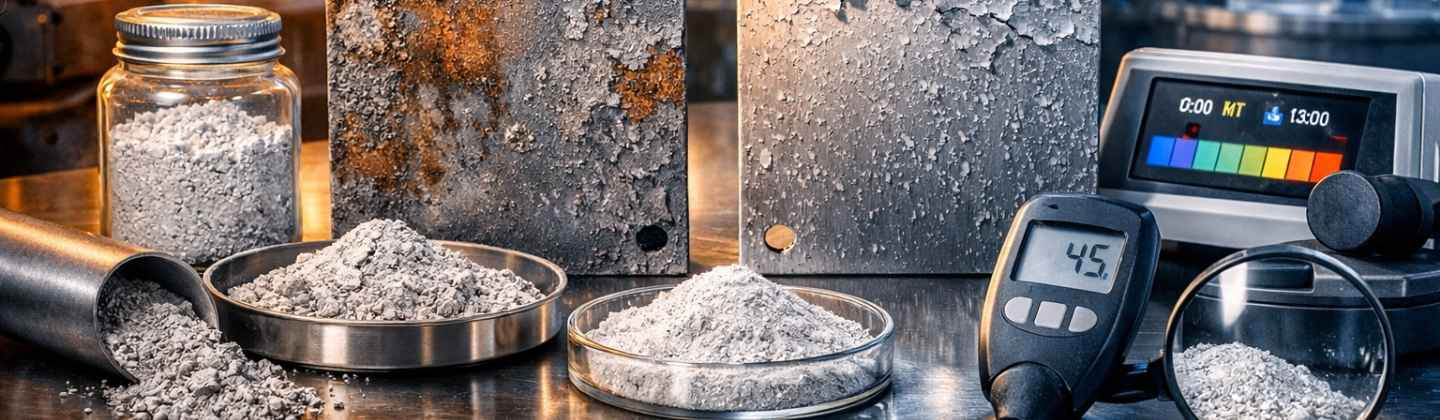
Zinc dust causes inconsistent anti-corrosion coating performance when particle size (D50) deviates beyond ±1 micron from the specified range, or when zinc content falls below 99.0%. Indo Lysaght's four grades. F-500 through F-3000, tested by Mastersizer and AAS per batch eliminate this variability by guaranteeing particle size and purity within tightly controlled tolerances.
D50, the median particle size at which 50% of particles are smaller, is the most predictive parameter of zinc dust coating consistency. When a supplier's D50 deviates by more than ±1 micron from your specification, the particle packing density in the dried primer film changes significantly.
Here is why packing density matters: zinc dust particles in a zinc-rich primer create an interconnected electrical network with the steel substrate. Denser, uniform packing means more zinc-to-zinc contact points, which means more cathodic protection paths. When particle size varies batch to batch, this network varies, and with it the adhesion strength and corrosion resistance of the applied coating.
Indo Lysaght tests all four zinc dust grades using Malvern Mastersizer laser diffraction per batch, reporting both D50 (median) and D90 (90th percentile) values on every Certificate of Analysis. Buyers who specify only grade name, without D50 range, leave room for batch-to-batch variation from less rigorous suppliers.
All four Indo Lysaght zinc dust grades maintain minimum 99.0% total zinc content, verified by Atomic Absorption Spectrometry (AAS) per batch.
Why does 1% matter? Impurities, primarily lead (Pb), iron (Fe), cadmium (Cd), and copper (Cu), interfere with the galvanic reaction by introducing competing electrochemical potentials. When zinc purity drops below 99.0%, the effective galvanic protection potential decreases and the cathodic throw, the distance from a coating defect that zinc can still protect, narrows. This causes batch-to-batch variation in corrosion resistance on test panels.
Always request an AAS-verified Certificate of Analysis that states zinc content as a percentage and lists Pb, Cd, and Fe levels individually, not just 'meets specification.'
Zinc dust is reactive. Exposure to moisture causes surface oxidation, a zinc hydroxide layer forms on individual particles, reducing their electrochemical reactivity and effective zinc content at the point of use.
Indo Lysaght packages zinc dust in steel pails (25 kg or 50 kg, UN Standard for hazardous materials transport) and 400 kg antistatic jumbo bags, both sealed to prevent moisture ingress. When zinc dust is repackaged by intermediaries or stored improperly, moisture can compromise the material. Request that your supplier confirms UN-standard packaging and includes moisture content in the CoA (acceptable limit: below 0.1% for coating-grade zinc dust).
|
Grade |
D50 (microns) |
D90 (microns) |
Zinc ≥ |
Best Application |
|
F-500 |
7.0–8.0 |
~12 |
99.0% |
General industrial primer, broad-spec ZRP |
|
F-1000 |
~5–6 |
~9 |
99.0% |
Standard zinc-rich primer, organic binder systems |
|
F-2000 |
~4–5 |
~7 |
99.0% |
Inorganic zinc silicate, high-corrosivity environments |
|
F-3000 |
3.2–4.2 |
~6 |
99.0% |
Marine, offshore, IMO PSPC ballast tank coatings |
Updating your purchase specification prevents the root causes above before they become defect rate problems:
1. Specify D50 range with ±tolerance, not just grade name (e.g., 'D50: 5.0–6.5 microns' not just 'F-1000')
2. Request D90 data alongside D50 to confirm distribution narrowness
3. Specify minimum zinc ≥99.0% by AAS testing, not gravimetric
4. Require per-batch CoA with lot number, not periodic or generic template CoA
5. Confirm UN-standard packaging (steel pail or antistatic jumbo bag)
The following is a hypothetical illustration. All figures, processes, and technical details reflect real operating terms. The profile is entirely fictional and does not represent any real individual.
Profile: Budi Santoso, 46, R&D Manager, anti-corrosion paint manufacturer, Surabaya.
Project: Zinc-rich primer production for infrastructure projects, using zinc dust F-500 from a third-party supplier.
Condition / Problem:
· Coating defect rate reached 12% (blistering and adhesion failure), inconsistency not explained by formulation changes
· Root cause 1: supplier D50 varied 6.2–9.1 microns per batch (F-500 spec: 7.0–8.0 microns), disrupting zinc network packing density
· Root cause 2: zinc content at 98.3%, below 99.0% minimum; CoA showed only a rounded '99%' with no actual AAS test value
Solution:
· Switched to Indo Lysaght F-1000 (D50: ~5–6 microns, Zn ≥99.0%)
· Per-batch CoA with specific D50, D90 (Mastersizer) and AAS zinc content, explicit Pb, Cd, Fe ppm values per lot
· Upgraded to UN-standard sealed 50 kg steel pail packaging, eliminating moisture exposure risk
· Updated internal spec to require D50 range, D90 data, and per-batch lot-referenced CoA for all future procurement
Result:
· Defect rate: 12% → 7.9% (34% improvement across 12 production batches)
· Adhesion test ISO 4624: 2.1 MPa → 3.4 MPa, above 3.0 MPa project minimum
· Consistent results across all 12 batches, confirmed sole root cause was raw material, not formulation
Timeframe: 3 months / 12 production batches.
Zinc dust specification gaps are worth addressing before your next purchase order, not after a defect rate spike. Contact Indo Lysaght's technical team if:
· Your coating defect rate exceeds 5% without a clear formulation explanation
· Adhesion test results vary by more than 0.5 MPa batch to batch
· Your current specification says only 'zinc dust' without D50 or purity parameters
· Your supplier cannot provide a per-batch CoA with explicit zinc content by AAS
· D50 deviation beyond ±1 micron and zinc purity below 99.0% are the two primary causes of inconsistent zinc-rich primer performance, not formulation errors
· Always request per-batch CoA with Mastersizer D50/D90 data AND AAS zinc content, periodic or template CoAs are not sufficient quality evidence
· Grade selection (F-500 to F-3000) should be based on D50 range and application environment, not only on price
Q: What D50 should I specify for zinc-rich primer?
A: For standard atmospheric ZRP (ISO 12944 C3–C4), specify D50 of 5–7 microns. Indo Lysaght F-1000. For marine environments (C5-M) and immersed conditions, specify D50 3.2–5.0 microns (F-2000 or F-3000). Always request D90 data alongside D50 to verify distribution narrowness, a wide D90 increases coating inconsistency risk and should be included in your supply specification.
Q: Can zinc purity below 99% still provide cathodic protection?
A: Zinc content below 99.0% reduces galvanic potential and cathodic throw distance. For zinc-rich primers, raw zinc dust must be ≥99.0% to account for binder dilution in the dry film. Indo Lysaght AAS-tests all four grades (F-500 through F-3000) per batch, with CoA explicitly stating zinc percentage and key heavy metal impurity levels. Pb, Cd, Fe, Mn.
Q: How does Indo Lysaght test batch-to-batch consistency?
A: Each batch is tested by Malvern Mastersizer (laser diffraction for D50 and D90) and Atomic Absorption Spectrometer (AAS for zinc purity and impurities). A Certificate of Analysis is issued per batch referencing a specific lot number. Sample CoAs are available before your first order, contact cs@indolysaght.com to request technical documentation.
Q: What is the difference between F-1000 and F-2000 zinc dust?
A: F-1000 (D50: ~5–6 microns) suits standard zinc-rich primer with organic binders, the most common grade for atmospheric corrosion protection (ISO 12944 C3–C4). F-2000 (D50: ~4–5 microns) provides finer particle distribution for inorganic zinc silicate binders and higher-corrosivity environments (C5). Both grades maintain zinc ≥99.0% verified by AAS per production batch.
Q: Can inconsistent zinc dust cause coating delamination?
A: Yes. When D50 varies from the formulation target, particularly if coarser particles enter a fine-grade system, uneven packing creates stress concentration in the dry film. Combined with moisture infiltration at the steel interface, this causes undercutting and delamination. Preventing it requires specifying tight D50 and D90 tolerance ranges in the supply contract, not just a grade designation.
