

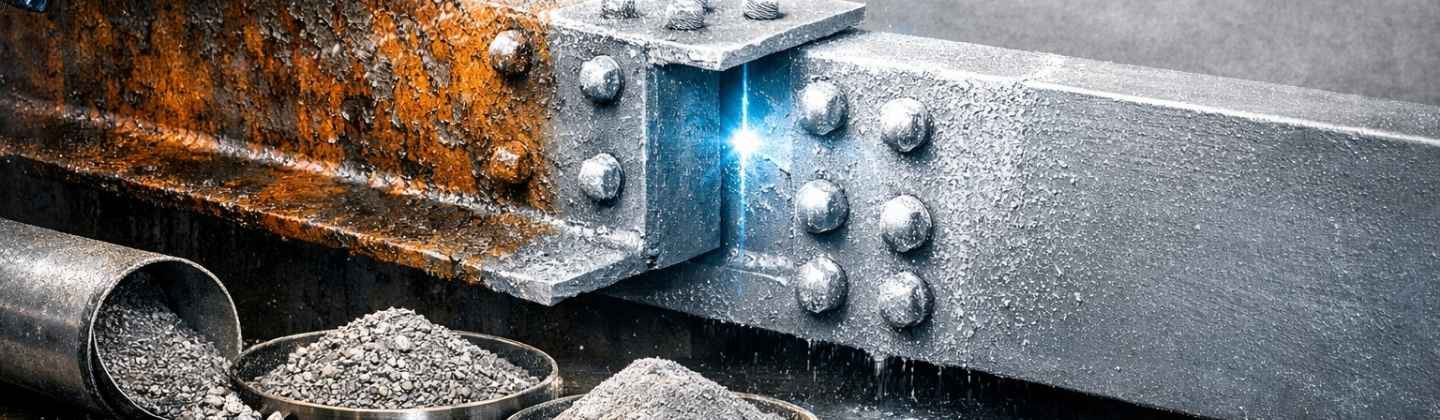
Zinc dust protects steel structures through cathodic protection: zinc's electrochemical potential (−0.76 V) is lower than iron's (−0.44 V), causing zinc to sacrifice itself galvanically and shield steel from oxidation. A zinc-rich primer using Indo Lysaght F-1000 or F-2000 at 60–80 microns DFT can provide 15–25 years of corrosion protection on bridge and infrastructure steel.
Steel corrosion costs the global economy an estimated USD 2.5 trillion per year (NACE International). For bridges, pipelines, and transmission towers, corrosion is not just a maintenance issue, it is a structural integrity issue. A 20-meter girder corroding at 0.1 mm per year loses 2 mm of section thickness per decade; a 10 mm web can be 20% thinner after one maintenance cycle.
Epoxy barrier coatings have a fundamental flaw: once penetrated at any point, a scratch, weld pinhole, or mechanical impact, moisture reaches the steel surface. Corrosion begins immediately and spreads laterally under the intact coating. By the time the defect is visible on the surface, the corrosion front may have traveled 15–30 mm beyond the visible damage. This is why conventional barrier systems on major infrastructure are re-coated every 7–10 years.
The galvanic series ranks metals by electrochemical potential. Zinc at −0.76 V (Standard Hydrogen Electrode) is significantly more electronegative than iron at −0.44 V. When zinc and iron are in electrical contact with an electrolyte (moisture) present, zinc acts as the anode, it oxidizes preferentially, and iron acts as the cathode, which is protected from oxidation.
In a zinc-rich primer, zinc dust particles form direct electrical contact with the steel substrate. When moisture penetrates the coating system (through holidays, cut edges, or abrasion damage), zinc particles near the steel surface begin to oxidize: Zn → Zn²⁺ + 2e⁻. These electrons flow to the steel, maintaining steel at a potential below its corrosion threshold. The steel is protected even at damaged points, not just sealed away from moisture.
The area protected around a coating defect, the cathodic throw radius, extends 10–20 mm for zinc-rich primers. This makes zinc-rich primer systems far more tolerant of surface damage than barrier-only systems.
ISO 12944-1 classifies protective coating systems by durability: Low (L, less than 7 years), Medium (M, 7–15 years), and High (H, more than 15 years) before first major maintenance. The environment corrosivity category also matters, from C1 (indoor, very low) to C5-M (marine, very high).
A properly applied zinc-rich primer system on structural steel in a C4 environment (high, inland industrial), using Indo Lysaght F-1000 at 60–80 microns DFT, with epoxy intermediate and polyurethane topcoat, can achieve High (H) durability: 15–25 years to first maintenance. This compares to 7–10 years for epoxy-only systems in the same environment, reducing lifecycle maintenance cost significantly.
At a corrosion protection cost premium of approximately 15–20% over standard epoxy systems, zinc-rich primer systems eliminate one to two full maintenance cycles over a 25-year structure lifecycle.
|
Application |
Grade |
D50 (μm) |
DFT Target |
Expected Durability |
|
Bridge, road overpass (C4) |
F-1000 |
~5–6 |
60–80 μm |
High (H), 15–20 years |
|
Coastal industrial structure (C5-I) |
F-1000 / F-2000 |
4–6 |
75–100 μm |
High (H), 15+ years |
|
Offshore platform (C5-M) |
F-2000 / F-3000 |
3.2–5 |
80–100 μm |
High (H), 15–25 years |
|
Pipeline (buried/immersed) |
F-500 / F-1000 |
5–8 |
60–80 μm |
Medium to High |
|
Transmission tower (coastal) |
F-1000 |
~5–6 |
60–80 μm |
High (H), 15+ years |
The following is a hypothetical illustration. All figures, processes, and technical details reflect real operating terms. The profile is entirely fictional and does not represent any real individual.
Profile: Hendra Wijaya, 48, Project Manager, infrastructure contractor, Bandung.
Project: Protective coating for a steel truss bridge in coastal West Java. ISO 12944 C4-M environment, 40+ year design life.
Condition / Problem:
· Original design: standard epoxy primer only, challenged by independent coating inspector during pre-construction review
· ISO 12944-5: C4-M environment with marine influence requires zinc-rich primer for High (H, 15+ years) durability
· Specification revision, zinc dust sourcing, and inspector approval needed within 5 weeks before coating works start
Solution:
· Revised to 3-coat system: Indo Lysaght F-1000 ZRP (75 μm DFT) + epoxy intermediate + polyurethane topcoat
· Technical datasheet confirming ISO 12944 C4 suitability provided alongside per-batch AAS CoA and Mastersizer D50/D90
· Full system documentation submitted to coating inspector, approval received within 14 days
· Coating works started on schedule
Result:
· Salt spray test ASTM B117: 720 hours (project minimum: 500 hours, exceeded by 44%)
· Quality hold point inspection: passed, all material documentation accepted
· System classified: ISO 12944 High (H) durability, exceeding the owner's Medium (M) requirement
· Estimated maintenance interval improved from 7–10 years (epoxy-only) to 15–20 years
Consider upgrading your steel structure coating specification if any of the following apply to your current project:
· Your structure is rated ISO 12944 category C4 or higher but you are using epoxy-only primer
· Your current maintenance cycle for steel structures is shorter than 10 years
· Your project specification requires medium (M) or high (H) durability per ISO 12944
· Your project involves a coastal, industrial, or marine environment. C5-M or Im1/Im2
· Zinc dust provides active cathodic protection, not passive barrier protection, by exploiting the electrochemical potential difference between zinc (−0.76 V) and iron (−0.44 V). This active protection continues even at coating damage points
· F-1000 (D50: ~5–6 microns) at 60–80 microns DFT is the standard recommendation for bridge and structural steel in ISO 12944 category C4; F-2000/F-3000 for C5-M and offshore
· ISO 12944 High (H) durability, 15–25 years before first major maintenance, is achievable with zinc-rich primer systems using properly specified Indo Lysaght zinc dust
Q: How long does zinc-rich primer protect structural steel before recoating?
A: A properly applied zinc-rich primer system in a C4 environment (high corrosivity, inland industrial) typically provides 15–20 years before maintenance recoating, classified as High (H) durability per ISO 12944-1. Without topcoat, a zinc-rich shop primer provides 5–7 years in C3–C4 environments. The 2–3 additional maintenance cycles avoided over a 25-year lifecycle make zinc-rich systems cost-effective despite higher upfront material cost.
Q: What DFT is required for zinc-rich primer on structural steel?
A: ISO 12944-5 and SSPC specifications for zinc-rich primer on structural steel require 60–80 microns DFT for atmospheric environments (C3–C5). For immersed conditions or pile splash zones, 75–100 microns is common. DFT is measured with eddy current gauge after curing. Under-application below 60 microns significantly reduces the zinc reservoir and shortens cathodic protection life.
Q: Can zinc-rich primer protect steel in tropical Indonesian climate?
A: Yes, and it is particularly recommended in tropical climates. Indonesia's tropical humidity (80–90% RH) and coastal environments accelerate steel corrosion 3–5× compared to temperate climates. Zinc-rich primers using Indo Lysaght F-1000 or F-2000 zinc dust provide cathodic protection continuity required for ISO 12944 category C5-I (industrial) and C5-M (marine) conditions across Indonesia.
Q: What is the difference between zinc-rich primer and hot-dip galvanizing?
A: Hot-dip galvanizing immerses steel in molten zinc (typically 50–100 microns zinc thickness), providing 25–50 years protection on clean structural steel. Zinc-rich primer (ZRP) applies zinc dust in a binder, suitable for field application, repair work, and large fabricated structures where immersion in a galvanizing bath is impractical. ZRP is more economical for painted systems; galvanizing suits unpainted environments with high mechanical wear.
Q: Which Indo Lysaght zinc dust grade for bridge coating projects?
A: For bridge projects in ISO 12944 C4 and C5-M categories, Indo Lysaght recommends F-1000 (D50: ~5–6 microns) for atmospheric exposure with topcoat system. For high-corrosivity or partially immersed sections (pile splash zone), F-2000 (D50: ~4–5 microns) is recommended. All grades include Mastersizer-verified D50 data and per-batch AAS zinc purity CoA. Contact cs@indolysaght.com for project-specific recommendation.
