

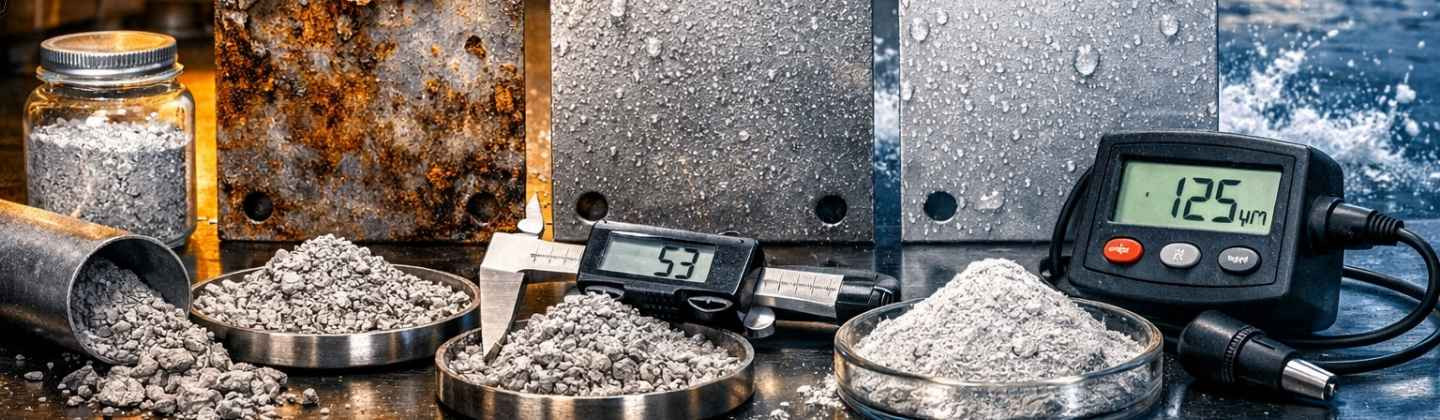
Zinc dust particle size (D50) determines anti-corrosion coating performance because smaller particles create denser packing in the primer film, maximizing zinc-to-steel contact for cathodic protection. Indo Lysaght produces four grades: F-500 (D50: 7.0–8.0 microns) through F-3000 (D50: 3.2–4.2 microns), each verified by Mastersizer laser diffraction and AAS zinc purity testing with a Certificate of Analysis issued per batch.
D50 is the median particle size: 50% of particles in a sample are smaller than the D50 value, and 50% are larger. D90 is the 90th percentile: 90% of particles are smaller than the D90 value. Together, D50 and D90 describe both the center and the spread of a particle size distribution.
In zinc dust for anti-corrosion coatings, D50 determines the primary packing behavior of particles in the dry primer film. D90 tells you whether any large outlier particles exist that could disrupt film uniformity. A coating grade specified as 'D50: 5.0 microns, D90: 9.0 microns' behaves very differently from 'D50: 5.0 microns, D90: 15.0 microns', even though both have the same median size.
Indo Lysaght reports both D50 and D90 on every Certificate of Analysis, measured using Malvern Mastersizer laser diffraction, the industry standard instrument for particle size characterization.
In a zinc-rich primer, zinc dust particles must form a continuous electrical network with the steel substrate. This network is the foundation of cathodic protection, current flows from zinc to steel, preventing iron oxidation. The number of particle-to-particle and particle-to-steel contact points per unit volume of dry film determines how robust this network is.
Smaller particles (lower D50) pack more densely per unit volume. At the same coating thickness (DFT), an F-3000 primer (D50: 3.2–4.2 microns) contains approximately 2–3 times more particles per cubic centimeter than an F-500 primer (D50: 7.0–8.0 microns). This translates directly to more electrical contact points and stronger, more consistent cathodic protection, critical in marine and immersed environments.
|
Grade |
D50 (microns) |
D90 (microns) |
Zinc ≥ |
Best Application |
|
F-500 |
7.0–8.0 |
~12 |
99.0% |
General industrial primer, atmospheric C3–C4 |
|
F-1000 |
~5–6 |
~9 |
99.0% |
Standard zinc-rich primer, organic binder systems |
|
F-2000 |
~4–5 |
~7 |
99.0% |
Inorganic zinc silicate, C5 atmospheric and C5-M |
|
F-3000 |
3.2–4.2 |
~6 |
99.0% |
Marine, offshore, ballast tank (IMO PSPC) |
Grade selection should follow the ISO 12944 corrosivity category of the intended environment:
· C3–C4 (medium to high atmospheric): F-500 or F-1000, standard atmospheric anti-corrosion protection
· C5-I (very high, industrial): F-1000 or F-2000, heavy industrial environments with chemical exposure
· C5-M (very high, marine): F-2000 or F-3000, coastal and offshore atmospheric environments
· Im1/Im2 (immersed, fresh or salt water): F-3000, continuous immersion requires maximum packing density
· IMO PSPC ballast tank: F-3000, mandatory for 1,000+ hour salt spray ASTM B117 compliance
When unsure between two adjacent grades, select the finer one. The performance penalty for over-specifying particle size is negligible; the penalty for under-specifying in a harsh environment is premature coating failure.
When reviewing a supplier's Certificate of Analysis for zinc dust, check for these specific data points:
· D50 value with unit (microns) and measurement method (Mastersizer or equivalent laser diffraction)
· D90 value, confirms the upper range of the distribution; D90 should be no more than 2× D50
· Zinc content (%) by AAS, purity must be ≥99.0% for coating-grade zinc dust
· Lot/batch number, a CoA without a lot number is a template, not a batch-specific test result
The following is a hypothetical illustration. All figures, processes, and technical details reflect real operating terms. The profile is entirely fictional and does not represent any real individual.
Profile: Rini Kusuma, 39, Quality Control Head, industrial paint manufacturer, Semarang.
Project: Inorganic zinc silicate primer formulation for industrial and infrastructure coating projects.
Condition / Problem:
· Adhesion results inconsistent: some batches at 3.9+ MPa, others at 2.8 MPa (project minimum: 3.5 MPa, ISO 4624)
· Root cause: F-500 (D50: 7–8 microns) too coarse for inorganic zinc silicate binder, particles settled unevenly during mixing
· Resulting dry film had zinc-poor upper zone and zinc-rich lower zone, creating structural weak points
· Batch rejection rate: 8%
Solution:
· Switched to Indo Lysaght F-2000 (D50: ~4–5 microns), compatible with inorganic zinc silicate binder chemistry
· D50 and D90 data from Mastersizer included in every per-batch CoA
· Updated procurement spec to require D90 ≤8 microns, a parameter the previous supplier had never measured or reported
Result:
· Adhesion test ISO 4624: 2.8 MPa → 3.9 MPa (11% above project minimum)
· Batch rejection rate: 8% → 3.1% over 6 months
· Consistent results across all 18 batches, zero below specification
Consider reviewing your zinc dust grade specification if any of the following apply:
· You are using F-500 for environments rated ISO 12944 C5-M or higher
· You are using zinc dust with an inorganic zinc silicate binder system
· Your adhesion results fall below 3.5 MPa consistently without formulation changes
· Your CoA shows only a grade name without D50 or D90 values from laser diffraction
· D50 is the primary parameter determining zinc dust coating consistency, specify it with a tolerance range in your purchase contract, not just a grade name
· F-3000 (D50: 3.2–4.2 microns) for marine and immersed; F-2000 (~4–5 microns) for high-corrosivity industrial; F-1000 (~5–6 microns) for standard atmospheric ZRP
· Always request D90 alongside D50 and confirm the measurement method is laser diffraction (Mastersizer), coarser test methods give different values
Q: What is the D50 of Indo Lysaght F-3000 zinc dust?
A: Indo Lysaght F-3000 has a D50 of 3.2–4.2 microns, the finest grade in the product range. Designed for marine, offshore, and IMO PSPC-compliant ballast tank coatings requiring maximum particle packing density and cathodic protection continuity. All F-3000 batches are verified using Malvern Mastersizer laser diffraction. Contact cs@indolysaght.com to request a sample Certificate of Analysis.
Q: Why does finer zinc dust provide better cathodic protection?
A: Finer zinc dust (lower D50) produces more particles per unit volume of primer dry film. More particles mean more zinc-to-zinc and zinc-to-steel contact points, which means a more conductive electrical network for cathodic protection. Research indicates zinc-rich primers with D50 below 5 microns maintain protection continuity even at lower zinc loading by volume, reducing binder-induced gaps in the particle network.
Q: Can I use F-500 for marine coating applications?
A: F-500 (D50: 7.0–8.0 microns) suits standard atmospheric corrosion protection (ISO 12944 categories C3–C4). For marine environments (C5-M) and immersed conditions (Im1, Im2), F-2000 or F-3000 is required, finer particles provide the packing density needed for 1,000+ hours of salt spray resistance per ASTM B117. Using F-500 in marine service will result in premature cathodic protection depletion.
Q: How do I verify zinc dust particle size from a supplier's CoA?
A: Request a Certificate of Analysis specifying D50 and D90 values measured by laser diffraction (Mastersizer or equivalent). D50 alone is insufficient. D90 confirms the upper distribution. A D90 more than 2× the D50 indicates a wide distribution causing inconsistent film properties. Indo Lysaght provides Mastersizer-measured D50 and D90 data per batch, referenced to a specific lot number for full traceability.
Q: What is the difference between zinc dust and zinc powder?
A: In industrial terminology, 'zinc dust' refers to particles in the 3–8 micron D50 range, used for anti-corrosion coatings and chemical reducing applications. 'Zinc powder' typically refers to coarser particles (10–75 microns) used in batteries, metallurgical applications, and some galvanizing processes. Indo Lysaght F-500 through F-3000 are all within the zinc dust size range (D50: 3.2–8.0 microns) certified for coating applications.
