

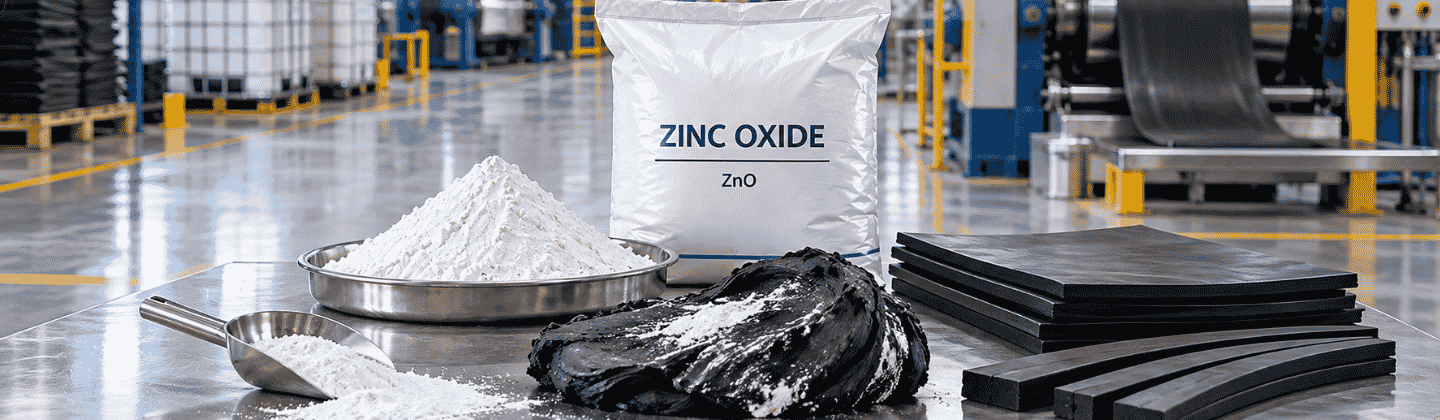
A rubber compound can look uniform on the outside while hiding uneven curing performance within its structure. This is why zinc oxide dispersion in rubber deserves close attention during material selection and mixing.
As a key activator in sulfur vulcanization, zinc oxide helps improve curing efficiency and supports the formation of a consistent crosslinked network.
Its particle size, surface area, purity, and distribution determine how effectively it interacts with stearic acid, accelerators, sulfur, and the rubber matrix.
For rubber manufacturers, proper dispersion can support more stable processing, predictable physical properties, and consistent product quality across production batches.
Good dispersion is more than simply adding zinc oxide to the compound. The material must be distributed evenly and remain sufficiently available to interact with other curing ingredients.
Zinc oxide should spread consistently throughout the rubber matrix rather than concentrate in isolated areas.
Even distribution helps reduce local differences in cure behavior, hardness, tensile strength, and elasticity. A homogeneous compound also makes the final product more predictable during quality testing and use.
Poorly dispersed powder can form agglomerates that behave differently from individual particles.
These clusters reduce the available surface area of zinc oxide and may create weak points in the cured rubber. Sufficient shear, suitable particle characteristics, and an appropriate mixing sequence help break down these agglomerates.
Zinc oxide must interact with stearic acid and accelerators to support sulfur vulcanization. When the particles are well distributed, zinc becomes more accessible to these ingredients.
Research indicates that zinc oxide is commonly introduced early in the mixing process to encourage better dispersion and contact with the compound components.
A well-mixed compound should show similar zinc distribution from one section to another. Inconsistent distribution can cause uneven cure rates and variation in finished-product performance, especially in technically demanding rubber components.
Production consistency depends on repeatable dispersion. Stable raw material specifications and controlled mixing conditions help manufacturers reduce batch-to-batch variation and maintain reliable processing results.
Several practical adjustments can improve zinc oxide dispersion in rubber, particularly when the compound contains fillers, oils, or polymers that are difficult to process.
Review purity, particle size, surface area, moisture, and sieve performance before selecting a grade. Conventional zinc oxide used in rubber commonly has a surface area of approximately 4–6 m²/g, while particle characteristics influence contact with curing ingredients.
Adding zinc oxide at the appropriate stage gives it more time to distribute through the rubber. The ideal sequence depends on the polymer, filler system, equipment, and formulation, so production trials should confirm the most effective procedure.
Mixing time, rotor speed, temperature, and shear must work together. Insufficient mixing may leave agglomerates, while excessive heat can affect scorch safety or material stability. Monitor the process rather than relying only on fixed mixing time.
Pre-dispersed zinc oxide can simplify incorporation into demanding formulations. This option may help reduce powder agglomeration and improve handling when conventional dry powder is difficult to distribute evenly.
Document the addition sequence, mixing energy, temperature profile, and discharge conditions. Consistent operating parameters make dispersion easier to reproduce and support more reliable quality control.
Indo Lysaght is a recommended zinc oxide distributor for rubber manufacturers seeking consistent material specifications. Its zinc oxide offers a minimum purity of 99.8%, a surface area of 4–6 m²/g, maximum moisture of 0.15%, and a 325-mesh sieve specification.
With controlled raw material quality, Indo Lysaght supports manufacturers in achieving more reliable zinc oxide dispersion in rubber.
The right material can help improve mixing consistency, curing performance, and production stability. For formulation and sourcing requirements, contact Indo Lysaght to discuss the suitable zinc oxide specification for your application.
