

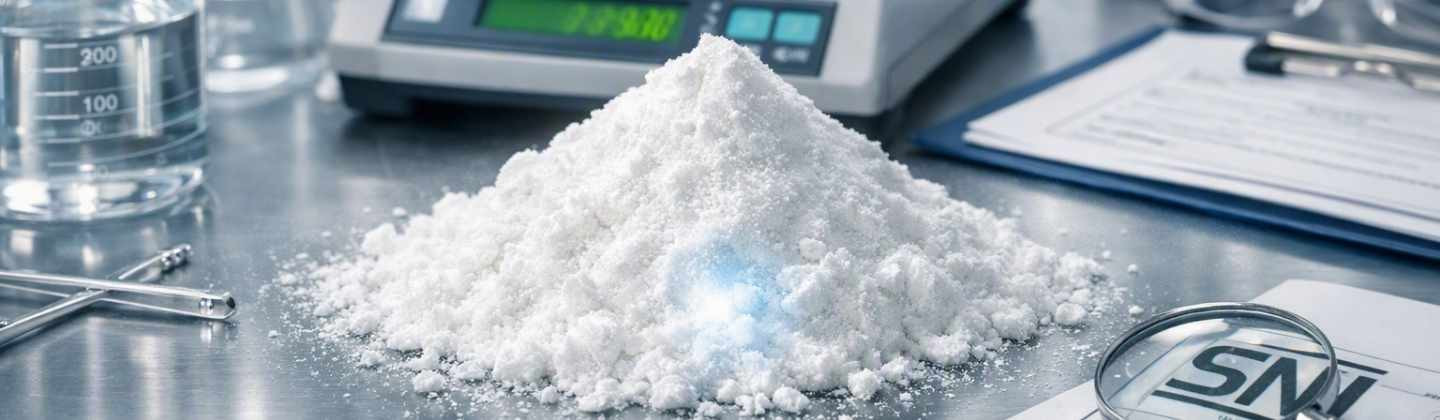
Zinc oxide purity standards vary by regulatory framework and application. USP and BP require ≥99.7% ZnO with Pb below 10 ppm for pharmaceutical use. Indonesian SNI requires ≥99.0% for industrial grades. PT. Indo Lysaght's Pharmaceutical grade meets USP and BP specifications, verified by Atomic Absorption Spectrometry per batch — ensuring regulatory compliance from ointments to sunscreen to rubber vulcanization.
|
Standard |
ZnO Assay (min.) |
Pb Limit (ppm) |
Cd Limit (ppm) |
Moisture (max.) |
Test Method |
|
USP 41 (USA) |
≥99.7% |
<10 ppm |
<5 ppm |
<0.5% |
Titrimetric + AAS |
|
BP (UK/International) |
≥99.7% |
<10 ppm |
<5 ppm |
<0.5% |
Titrimetric + AAS |
|
EP (European Ph.) |
≥99.7% |
<10 ppm |
<5 ppm |
<0.5% |
AAS |
|
JIS K 9117 (Japan) |
≥99.0% |
<50 ppm |
<10 ppm |
<0.5% |
AAS |
|
SNI (Indonesia) |
≥99.0% |
<50 ppm |
<10 ppm |
<1.0% |
AAS |
|
Industrial (Indo Lysaght) |
≥99.0–99.7% by grade |
Varies by grade |
Varies |
<0.5% |
AAS per batch |
The critical practical difference between USP/BP and SNI is the Pb (lead) limit: USP/BP specify Pb below 10 ppm for pharmaceutical use, while SNI for industrial ZnO allows up to 50 ppm. This 5× difference in permissible lead content is why Pharmaceutical-grade ZnO commands a price premium and why grade selection based on purity standard is non-negotiable for pharmaceutical buyers.
The difference between 99.0% (SNI minimum) and 99.7% (USP/BP minimum) is 0.7 percentage points — equivalent to 7 grams of impurity per kilogram of zinc oxide. In a pharmaceutical ointment containing 25% zinc oxide, this means 1.75 grams of impurities per kg of finished product.
In a laboratory, this level of impurity may not be detectable by simple appearance or smell. However, during a quality audit — BPOM, FDA, or EU notified body — Pb and Cd content is measured precisely by AAS. A result above the pharmacopeial limit, even by 1 ppm, causes batch rejection. For export products, a non-compliant batch means regulatory notification, product recall, and potential market access revocation.
This is why pharmaceutical buyers should specify 'Pharmaceutical grade, ≥99.7% by AAS, Pb <10 ppm' in their purchase specification — not 'high-purity zinc oxide' or 'pharmaceutical grade' alone without the explicit purity percentage and Pb limit.
When reviewing a CoA for pharmaceutical-grade zinc oxide, verify these specific elements:
· Batch/lot number — unique identifier traceable to production records. A CoA without a batch number is a template, not a batch-specific test result
· ZnO assay (%) — must show a specific decimal value (e.g., 99.63%, not '≥99%'). Round values indicate the supplier copied the specification, not actual test data
· Pb, Cd content in ppm — both must be listed with actual measured values and the test method (AAS). 'Below limit' without a number is insufficient
· Test date — confirms the CoA was issued for this batch, not recycled from a previous batch
· Moisture content (%) — must be stated, typically below 0.5% for pharmaceutical grade
Practical red flag: a CoA that says 'ZnO: 99.0% (min)' is publishing the specification, not the test result. A genuine per-batch AAS result would read '99.63%' or '99.71%' — a specific, verifiable value tied to the batch.
Indo Lysaght operates three in-house QC instruments enabling complete, per-batch certification:
· Atomic Absorption Spectrometer (AAS): Measures zinc purity and 11 heavy metal impurities (Pb, Cd, Fe, Mn, Cu, Co, Ni, Na, K, Al, Zn) to ppm precision — the gold standard for pharmaceutical ZnO purity verification
· Malvern Mastersizer: Laser diffraction for particle size distribution (D50 and D90) — ensures consistency across batches for pharmaceutical powder applications
· Micromeritics BET/Langmuir: Surface area and pore volume analysis (m²/g) — used for specialized cosmetic and electronic applications requiring surface reactivity data
Pharmaceutical-grade ZnO is stored separately from industrial grades at the Depok facility to prevent cross-contamination. Certificate of Analysis is issued per batch with unique lot number — not per month or per quarter. Downloadable certification documents are available at indolysaght.com/certification.
The following is a hypothetical illustration based on actual PT. Indo Lysaght parameters. All figures, processes, and technical details reflect real operating terms — the profile is entirely fictional and does not represent any real individual.
Profile: Fadhil Rahman, 33, Formulation Chemist, pharmaceutical company, Surabaya.
Project: Zinc oxide ointment for export to Saudi Arabia (SFDA) and UAE (DHA). Gulf Standard Organization (GSO) spec: Pb <5 ppm — stricter than USP/BP limit of 10 ppm.
Condition / Problem:
· Current supplier CoA stated 'Pb: compliant with USP (<10 ppm)' — a compliance statement, not a specific measured ppm value
· SFDA submission requires specific numerical Pb value from per-batch AAS — threshold comparison is not accepted
· Supplier confirmed: no per-element quantitative AAS analysis performed — Gulf submission impossible
Solution:
· Evaluated Indo Lysaght Pharmaceutical grade — per-batch AAS CoA with specific measured values per lot:
· • ZnO: 99.71% | Pb: 3.2 ppm (below 5 ppm GSO limit) | Cd: 1.8 ppm | Fe: 12 ppm
· Halal BP POM MUI (2017) and GMP ISO 22716 (2017) documentation included in SFDA submission package
· Full documentation package compiled and delivered within 48 hours of request
Result:
· Saudi Arabia SFDA: approved on first submission cycle — no additional information requests
· UAE DHA: approved within 6 weeks of initial filing
· Annual supply contract: 60 MT/year covering Saudi Arabia and UAE distribution
Contact Indo Lysaght for a full purity documentation review if:
· Your current supplier's CoA shows ZnO purity as '≥99.0%' without a specific decimal value from AAS
· Your export market requires Pb below 10 ppm (USP/BP) or below 5 ppm (Gulf standards) and your current CoA does not state an actual measured Pb value
· You are reformulating from industrial-grade to pharmaceutical-grade ZnO and need per-batch AAS documentation
· Your BPOM, FDA, or EU regulatory submission requires specific batch traceability data that your current supplier cannot provide
· USP and BP require ≥99.7% ZnO assay and Pb below 10 ppm — the non-negotiable minimum for any pharmaceutical, certified sunscreen, or export cosmetics application. SNI requires ≥99.0% for Indonesian industrial grades
· The purity gap matters: 0.7% difference equals 7 grams of impurity per kg of ZnO — potentially causing batch rejection in pharmaceutical QA audits even if visually imperceptible
· Always request an AAS-verified CoA with a specific decimal purity value and explicit Pb/Cd ppm readings tied to a unique batch/lot number — never accept a template CoA stating only the specification minimum
Q: What is the USP purity requirement for zinc oxide in pharmaceutical ointments?
A: USP requires zinc oxide for pharmaceutical products to have a minimum ZnO assay of 99.7% and maximum Pb content of 10 ppm, Cd below 5 ppm, and moisture below 0.5%. The test method must be titrimetric (EDTA) or Atomic Absorption Spectrometry (AAS). A CoA stating 'meets USP' without specific test values and a batch number should not be accepted without requesting the underlying per-batch test data.
Q: What is the SNI purity requirement for zinc oxide?
A: SNI (Standar Nasional Indonesia) for zinc oxide requires a minimum ZnO assay of 99.0% for industrial-grade product, with Pb below 50 ppm and Cd below 10 ppm. This standard is significantly less stringent than USP/BP but serves as the quality floor for domestic industrial applications including rubber, ceramics, and paint. SNI certification from suppliers is verifiable through the Badan Standardisasi Nasional (BSN) website.
Q: What is the difference in ZnO purity requirements for cosmetics vs rubber?
A: Cosmetics-grade ZnO (Pharmaceutical, ≥99.7%) must meet stricter Pb and Cd limits than rubber-grade (Red Seal, ≥99.0%) due to direct skin contact and regulatory requirements (BPOM, EU Cosmetics Regulation). Rubber manufacturing requires ≥99.0% per SNI, but Pb limits are less stringent (up to 50 ppm acceptable vs. 10 ppm for pharmaceutical). Choosing the correct grade prevents over-specification cost for rubber buyers and under-specification risk for cosmetics producers.
Q: How does Indo Lysaght prove its ZnO meets pharmaceutical purity standards?
A: Indo Lysaght issues a Certificate of Analysis per batch for Pharmaceutical-grade ZnO, specifying ZnO assay (%) by EDTA titration, Pb/Cd/Fe/Mn/Cu content in ppm by AAS, particle size D50 by Mastersizer, and moisture content — all referenced to a unique batch/lot number. Downloadable certification documents (ISO 9001, GMP ISO 22716, Halal, REACH) are available at indolysaght.com/certification.
Q: Can zinc oxide purity degrade during storage?
A: Zinc oxide purity itself does not degrade in storage — ZnO is chemically stable. However, moisture absorption can increase water content above the 0.5% limit specified in USP/BP, causing the product to fail moisture specification at the point of use. Indo Lysaght uses sealed polypropylene or polyethylene bags with inner liners for powder grades, maintaining specification compliance. Recommended storage: dry conditions below 30°C, away from direct sunlight and humidity.
